I
We walk always on graves. We pass through absences we cannot quantify nor ever fully understand. We walk over the dead, known and unknown, memorialized and ephemeral. When we choose to pause, to reflect, to drag our focus away from the myriad tricks this modern world conjures to distract us from everything meaningful, we are reminded of death’s proximity.
II
My childhood copy of Edith Hamilton’s Mythology remains on my bedside bookshelf. As a kid I read it so often I can still remember the position of specific stories on their respective pages. My mother had to laminate its cracking cover at the elementary school where she taught to keep it from disintegrating. Its stories had been drawn from a range of Greek and Roman myths and plays. They blur distinctions between religion, theater, and actual history.
Greece had a mountain upon which ethereal gods lived, a volcano in which a disfigured deity forged armor. Men designed (and built!) a labyrinth so complicated it could not be escaped. Other men fought a ten-year-long war over a single city. Apollo guided an arrow to Achilles’s unprotected tendon. Prometheus suffered, chained to his rock, Io suffered, untethered, bedeviled by flies, parched by heat. Helios drove four horses to carry the sun across the sky. Icarus flew too close to it and plunged into the sea. And so on, mysterious and magical.
But those figures also felt real to me. They struggled. They were inconsistent in their actions, capricious in their judgements, like actual people I knew. Subjected to impulses of desire, jealousy, and revenge, they also had agency, or even the powers of gods, but they were still unable to escape their fates. In this sense their world resembled school playgrounds, with their fluid hierarchies and variable punishments. Odysseus was way cooler than anyone I encountered in comic books. It felt possible that a nearsighted, skinny boy could still grow up to be him: wily, strong, a leader of men. I was obviously never going to be Superman. That ship had sailed.
Years later I read Thucydides’s History of the Peloponnesian War, which details the generations-long struggle between Athens and Sparta. A pivotal moment in that conflict occurred after a six-year lull in fighting, when Athens decided to preemptively attack Syracuse. It was only when I studied the maps of that invasion that I realized how expansive the real ancient Greek world had been.
Many kilometers separate Athens from Syracuse, which lies on the Sicilian coast. Scylla also lies on Sicily, Charybdis in Italy, Troy in Turkey, Atlas holds the sky aloft in Morocco, where he could overlook the Atlantic. Ancient Greeks would scorn the tourist’s vision of the Mediterranean as a postcard-blue, tranquil lake, to be floated upon in overstuffed cruise ships. They recognized it as a treacherous, wine-dark sea, navigable only in fragile wood boats, roiled by tempest, human threat and unpredictable fate, by terrors best explained through analogy.
Syracuse withstood the Athenian invasion. Archimedes once ran naked though its streets, crying eureka. He had conceptualized displacement, the weight of our presence in the world. Aeschylus saw his plays performed in Syracuse, presumably while clothed. Its amphitheater, sometimes called the most beautiful on earth, lies curved within a hillside, and looks over the city below to the ocean beyond. Independence and displacement and drama. Ancient themes that still resonate today, even as technology threatens to subsume our humanity.
In 2019 our family had the opportunity to move to France. That brought Sicily, which I’d longed to see since boyhood, within reach. I carved out a three-day trip to the island and sped from one end of it to the other, transforming places I had imagined into memories. I saved Syracuse for last. I entered the cool darkness of the Ear of Dionysius, an artificial cave chipped into the walls of the quarry from which the theater’s stones had been carved. I sat at the top of the theater, marveling at its view, silently judging those who had dismantled its proekenion to form now-ruined castle walls. I smiled at the park map, upon which someone had penciled a question mark after the red dot and Voi Siete Qui (You Are Here) indication. Very little distinguishes comedy from existential dread.
Possibly as little as twenty meters, which is all that separates the theater from the quarry. The Athenian invasion had ended in disaster. At least 20,000 of its soldiers were killed, captured, or sold into slavery. Many had been deposited in that same quarry, creating the first concentration camp. They scratched desperate graffiti on its walls. The Ear had also, according to some accounts, been shaped to amplify their tortured screams, and thus to terrorize their compatriots. Citizens of an affluent, arts-minded proto-democracy, sacrificed not for gain nor glory nor freedom, but abandoned to their terrible fates. Few records of their names survive. They starved to death within earshot of a beautiful theater they would never see. Perhaps, in their misery, they even heard snippets of Aeschylus. I considered, in silence, on the ground where they had died.
Archimedes’ tomb, once marked by a sculpture displaying his favorite mathematical proof and restored by Cicero, has long since been lost. Aeschylus died nearby. According to one legend replete with classical Greek irony, an eagle accidentally dropped a tortoise upon him. He had been staying outdoors to thwart the prophecy that a falling house would kill him. He wrote Greek tragedies, he also understood fate, he should have known better.
Homer attributed glory and magnificence to the deaths at Troy. None of Odysseus’s crew returned home. In recorded history, thousands of Spartans and Athenians died, scattered across the eastern Mediterranean. Hundreds of ships lost. Reading about these thrilled me when I was a kid. Odysseus’s dead crew amplified the triumph of his return. Shipwrecks were not sunken graves, remnants of terror, but opportunities for us, with our modern wisdom, to retrieve amazing artifacts. But with age came the awareness that nothing meaningful distinguishes us as people from ancient Greeks. Their stories and histories reflect our deepest humanity and thus make us aware of our own fragility, recognizing that we will also fall, nameless, into oblivion.
III
Three hectic days across Sicily, primarily in cities, had wearied me. Agitation and noise define urban Italy. The kid who spent his summers reading Edith Hamilton grew up to be someone who prefers stillness to bustle. I sat in my car, overlooking the now-empty, now-silent quarry/concentration camp, beside a statue of Icarus (upside down, suspended between two stones, one hand extended almost gracefully to the sea below; another body lost without physical trace). I had six hours until my flight home, but I had seen all I had come to see.
I considered my rental car map. Between me and the airport, kind of, lay the Necropoli di Pantalica. A place apart from myth and thus completely unknown to me. Small, winding roads led there. It looked quiet. I put the car in gear. My only expectations were to avoid the beaten track, see an ancient grave or two, and end my trip with some solitude.
Those narrow roads, sporadically paved, threaded up and away from the industrialized coast. I passed a concrete pillbox, slouched within an unkempt thicket, covered with graffiti, a relic from a more-recent war. But I encountered no cars. None coming down, none jittering on my back quarter to express Sicilian irritation at my unreasonably moderate speeds. Switchbacks and breaks in hedges allowed bright peeks into farms, over vistas to the sea, glimpsed and gone. The last two towns before the necropolis, Cassaro and Ferla, crowned their respective hills, perhaps five hundred meters apart for an eagle, separated by three squiggling kilometers of rutted, noisy road.
Then: quiet. I turned down a loose gravel track and had to execute a clumsy five-point turn to park in some roadside weeds. I saw only two other cars there. One, a late-model Mercedes with license plates from Germany, the other a small, battered Fiat. I estimated its age to be roughly that of my laminated copy of Mythology.
The gate to the site lay open. Its very existence amused me. No fences separated the park from the road, so it would have been easy to sneak in. What access might the gate prevent? Or what spirits might it constrain? Behind it lay a small building, its exhibits too limited to allow it the designation of museum. An attendant, perhaps my age, labored over an old watch, its tiny bright pieces disassembled across a scarred counter. He reluctantly diverted his attention from his work to me.
I know little Italian, he not much English, so we settled into rudimentary French. No entry fee. He indicated that I should take a picture of the faded, measurement- and scale-free map tacked to the wall. I did so, more to honor his amiable insistence than from any real confidence in its utility. I asked where we were, since it lacked any trace of a Voi Siete Qui. He shrugged and pointed to its left. Existentially, I suppose, I knew precisely where I was. Somewhere between the beginning and the end. With an invisible question mark to acknowledge uncertainty.
After I passed through the gate I continued down an uneven footpath, perhaps as wide as I am tall. A familiar but infrequent feeling surrounded me. I have heard Jerusalem described as a thin place, and found it to be so, where the separation between earth and heaven feels porous. Likewise Chaco Canyon and Kyoto. At the necropolis the divine also felt immediate. A psychological creation or actual proximity to another realm, I cannot be sure, but either way it left me in a resonant state. These have become rare, in our modern lives, tethered to devices and thus aggressively manacled to a clamorous world that neither knows nor cares about our circumstance, that interrupts with immediate expectations and selfish considerations.
The path, according to the picture of the imprecise map displayed on my now-isolated phone (which proclaimed NO SIGNAL, in all caps, an emergency or miracle, one), made a wavering V, down one side of the valley, across a stream that I could hear but not yet see, and then back and up along the opposite bank. The rough hewn (by whom? when? and how?) path, sporadically overgrown by weeds, kept my progress slow.
Then the tombs began to appear. Or rather, I began to see them, since the newest among them had been created hundreds of years ago, the oldest, more than seven thousand. Seven thousand years, two thousand years before Egypt’s pyramids. Across the valley, dozens more emerged, at various altitudes, in clusters and alone.
Some remained precise and distinct, others had suffered partial collapse. Some were, perhaps, only natural caves. Some appeared so small I wondered if they had been made for children, others felt large enough to serve as a family crypt. Many had a layered depth, shallower rectangles framing their actual entrances. A setting, I thought, for some type of door, though no trace of those, if they ever existed, remains.
It took work to hack these from the bones of the earth. “Hewn from the living rock” is a phrase I had always loved but never before fully understood. The rock is bone, quiet and still, but it’s not dead. To carve a space in it, rather than build a structure upon it, means any object placed there is held within the very body of the world. Clasped by a fist, not offered upon a palm. Individual chisel marks still appear on their walls, recalling and contrasting those I’d seen hours earlier, in the Ear.
Many of these tombs were reused, I later learned, multiple times. Even if it took a century for nature to scour all trace of their previous occupants, that means some of them could have held remains from forty or fifty different human generations. A handful had been repurposed by Christians, only a thousand years ago. Perhaps they felt the same thinness I did. Perhaps they just appreciated the symbolism of emptied tombs. The entire valley aggregated death and memory, offering not celebration, nor defiance (Egyptian pyramids, again), but a cumulation of our most fundamental human realities. We have always died, we always will; we have always become dust, we always will; we have always mourned, and we always will.
I heard voices across the valley but saw no one. Perhaps the Germans. Not Italian. Their cadence too staccato, lacking volubility. I had only been walking for half an hour but I had already fallen into an isolated stillness that transformed their human sound into a jarring affront. In that quiet place, along the eastern shore of an island, isolated by seas, far from any major city, separate from the flow of time. An island conquered and lost on a dozen occasions, with associated casualties. Sicani, Phoenicians, Greeks, Carthaginians, Romans, Byzantines, Arabs, Normans, French, Spanish, Italians, Germans, Americans, and Italians again. The absence of spectacle preserves the essence of the valley. What is there to loot? Nothing. Only empty tombs, staring dark from pale rock faces.
I crossed the stream. Limestone fragments, red and black pumice, and smooth pieces of gray chalcedony lay beneath its clear surface. I ascended to the path’s opposite summit, an empty gravel parking lot, scarcely more than a wide space at the end of an unpaved road. I encountered no people but a dozen of Italy’s ubiquitous cats. I turned back. I saw crushed gravel, pebbles lining the streambed, but no evidence of the myriad chips that must have been created during the production of those tombs, and no grave markers, no signifiers of humanity other than those monumental absences.
The weather remained pleasant, the solitude a relief. I kept moving slowly. Then I began to feel the import of absence borne by those thousands of tombs. They inspired awe, not wonder. I felt empathy for the living who made them, for the scores, the vast numbers of suffering mourners, burying their dead with little remaining artifice. Those silent layers of grief reflect more accurately the endless void of death, in their quiet anonymity, than could any monument. Even the great pyramids will, after all, one day be reduced to sand. At the necropolis community takes precedence over individuality, there are no bones, no art, and no names, no specific memorials, just an accumulation of absence.
Recrossing the stream I did something I had never done before. I stole two pieces of that rough, pockmarked, once-lava, airy stone that had bubbled from beneath Mt. Etna’s vague shadow, under which Hephaestus might still labor, beneath which Persephone might live for half the year. My mother’s admonition ran through my mind: what if everyone did that? But everyone else there was dead and vanished and the river would carry more downstream or grind these two to dust anyway and besides, I am not everyone. Justifications.
I returned. I had to duck under the lowered gate. The door of the small visitor’s center was closed, its attendant gone. My car the last one still there. So the German tourists must also have departed. If the map was accurate, I had passed them without seeing them. Had they hidden in one of the tombs, spaces I had avoided entering out of respect? The eerie sensation of having been watched – palpable in real life, unlike the surreptitious ubiquity of online surveillance – irritated me because I had assumed some special privacy there.
I stared back down the overgrown path, scanned what I could see of the valley to try and seal it in memory and felt, suddenly and surprisingly, an immense weight. I sat in the car. The weight left me weary, helpless, and lonely. The notion of an hour’s drive to the airport overwhelmed me. Walking the trail had not been particularly challenging. Perhaps some uneven footing, slightly unseasonal warmth. Profound exhaustion settled into me anyway. The exhaustion of forced reflection, following days of harried traveling, months of living in a foreign country, of being immersed in a third language I did not yet understand.
I sat, far from home, far from family, beyond communication with anyone known or unknown. Close to the accumulation of death, the absence of death, the weight of death. I was the sole named being there. The only living soul.
That was the day I decided to stop killing myself.
IV
Many of us kill ourselves in slow, unsteady ways; struggling to meet artificial deadlines, chasing shallow and/or selfish goals. Responding to spurious corporate demands instead of actual human needs. Creating anxiety in others to enrich ourselves. Attributing immense value to things of no consequence. These are not new revelations to any thoughtful person. But for me it took the anxiety of travel, starting with a very early morning flight, a meaningless but stressful car accident, speeding around an ancient island to see everything I had so long hoped to see, struggling with language and directions and approaching exhaustion to fuse my disparate thoughts into something simple and clear.
I stayed there long enough, in active reflection, that when I glanced at my watch I realized I had to leave to make my flight home. I departed a different way, veering northeast. Three hundred meters ahead I pulled from the road to look back and take a final picture. The valley had not moved, but it had vanished, fallen beneath the layers of trees and undergrowth.
As I continued I thought of Aeschylus and Archimedes and wondered if they had ever visited that necropolis. I decided not. It lacked monuments or a theater and besides, they both surely subscribed to the Greek idea that immortality exists only when we live on in the memories of others. Thus Icarus has, so far, achieved eternal life. I thought about the pages of notes for novels I had never written, fully cognizant that the jump from notes to a book approximates the gap between a Lego model and an actual ship.
I imagined that all writers share an innate sense of urgency, particularly early in their careers, since no one is asking them to finish a poem or refine the ending to a story or to please complete a novel. That drive comes from within. I only finally received it, or perhaps allowed it to surface, that day. To consider death is to consider truth. To what must we be true? Given that we have only our bright brief years here, given that we will dissolve in tombs, forgotten?
It would be misleading to suggest that my revelation sprang, Athena-like, from nothing more than a few hours’ consideration. My kids had seen me write every day. My wife supported me when I took vacations to… work on writing. In guiding my daughter’s college search, I had said that career success and money and prestige mattered less than relationships and fulfillment. I told her, therefore, that she should go wherever she wanted, regardless of meaningless, industry-driven best-university ranking systems. She asked:
“Why are you telling me to go pursue my dreams when you’re not pursuing yours?”
My wife smiled. “I know we promised each other that we’d present a unified front with our kids,” she had said, in effect. “But that’s not a kid thing to ask. So I’m going to say she’s not wrong.”
My daughter wasn’t entirely right, though, either, since one of my dreams was and is to give my kids both a deep sense of security and a broad sense of curiosity. I never wanted them to worry about money. I wanted them to see the world. Those dreams require resources, resources that writers typically demand, not supply. Why didn’t I just write? My wife wanted me to. My kids wanted me to. Because, because, because. Because until that day, in a rental car on a beautiful afternoon five hundred miles from anyone I knew, that path had only felt possible, not essential.
I returned to begin unwinding my old life and establishing a structure for a new one. Stress did not vanish, but it shifted from the external to the internal. Ignoring foolish demands on my time grew easier. Forcing myself to confront and repair broken sentences became harder. As competing demands dissolved, the demands of focus – gone the excuses that external work provided – grew more difficult. But my contentment, not just working but following a pursuit of meaning, rose.
V
A good friend, after listening to me describe my decision-making process and detail how I would leave my job and set my goals, thought for a moment. I imagined he might ask about the distinction between self-fulfillment and selfishness. Or about how long I would try to make this work, how I would measure success, or acknowledge failure.
“I’m glad you’re doing what you want,” he said, instead. “But do you get nervous that artificial intelligence is just going to crowd you out?”
No. Yes? No. No, because we can experience kinship across centuries and distance, even beyond death. A boy in South Carolina can dream of Odysseus. Billions of people find some connection to Jesus or Mohammed or the Buddha. We suffer. We despair. We remember. We do not measure, we feel.
The physical valley of the necropolis began when a single grain of sand diverted the first raindrop that fell upon a dry stone. Subsequent drops followed along that initial, random path, and millions more opened a substantive rift. Not by design, not through efficiency, but through happenstance followed by repetition upon repetition upon repetition. Did understanding create such a place? No. The valley itself demonstrates erosion. The five thousand portals to afterlife or grief or memory demonstrate creation.
AI likewise substitutes frequency for knowledge. It seeks nothing but averages. I used to fly dozens of times a year, which necessitated repeated trips through my local airport. I have only visited the necropolis once. You, a human, already know which place holds greater meaning to me. My phone often displays the weather for MSP. Utilitarian, but superficial. It has never acknowledged my two hours at the necropolis. This gap between data and understanding distinguishes humans from systems.
We remember those who understand themselves, and love those who understand us. We remember Archimedes running naked after he understood displacement, we remember Aeschylus because he understood drama. As a kid I loved Icarus because I understood that he did what I would have done. As adults we remember Icarus as a cautionary tale, because he did not understand limitations.
I often reconsider these stolen rocks, carried across seas and years and an ocean, resting on a table I inherited only upon my mother’s death. Mementos, triggers not for precise recollection, but for muddled sentiment. No machine will quantify the weight of something so small, a few ounces, and feel the heaviness of a dozen sometimes-conflicting emotions. Artificial intelligence, as my mother said about people who frustrated her, knows the price of everything, but the value of nothing.
We are defined as much but what confuses us as by what we remember, as much by what we wish to know as what we already know, as much by what requires discovery as by what is apparent. No machine will run naked down the street. They won’t be afraid of a prophecy and sleep outdoors. They will never fly too high. They’re ignorant to the fact that we possess something immeasurable and indelible: our souls.
Our souls compel us to confront death. Not out of fear, but in more-affirming, more-alive ways. How much can we learn, or see, or discover in our short time here? How well can we establish our Greek immortality in the minds of others, not by living our lives with the goal of being remembered, but living our lives with the goal of understanding? Understanding the unquantifiable: people, love, community, the breadth and fragility of creation.
VI
I hammered out the first draft of this piece in early 2020, upon my return to our tiny apartment in Paris. Hammered a stone-proximate literal word, a writing-proximate figurative one. Sometimes a draft becomes an enormous block from which I file away the unessential into something meaningful and distinctive and sharp. Sometimes I sit and pound away until I have created a space, however small, however dark, to give shape and expanse to something I do not understand. With some luck and some skill that space might achieve a modicum of permanence, to be rediscovered and recognized sometime later, by myself, or by someone else.
COVID truncated our time in France. COVID left millions of absences around the world, incomprehensible numbers. I am reminded of Stalin’s brutal assertion that “A single death is a tragedy; a million deaths is a statistic.” Stalin would have loved AI.
We returned to the States. I negotiated a reduction in my work schedule to four days a week. Step one of three, I thought, into my new life. But two weeks later, long before I had determined how to best use that full empty weekday, my mother called and said her back hurt. Even at her age, 79, because of her commitment to fitness and healthy living, this triggered no particular alarm for me. Except that she never complained about anything physical. Her psyche had been forged on generations of stoic perseverance. I had no reason to expect that in the next one hundred days she would go from healthy to hospice. And then be gone.
Thirty years earlier my father had died without warning. I had been away at college. In those days before cell phones, on a Saturday night, even on a small campus it took my roommate over an hour to find me. I called home, received the news, and cried myself to sleep. No farewells, no time to ask questions, no chance to communicate love, just a moment when presence became absence.
My sister and I both have many memories of our parents expressing, with vehemence, their disdain for expensive end-of-life care, which they viewed as financially unsound (that money better spent on education, or given away) and emotionally unwise (when it’s your time, you should accept that it’s your time). So when my mother’s diagnosis arrived we knew she would opt into hospice.
That left time, a lot of time, relative to my dad, in which to talk, to forge that final link in the chain between us. It wasn’t enough time. I suspect it never is. Our questions always outnumber our lives. She said two things, though, that I will always remember. When I asked if she were afraid she said no. I believed her. She had always been a person of profound faith, she prayed every day, in one sense she had been preparing for her own death for most of her life. “But I thought I’d have more time,” she said. She paused, and I think we both imagined all the things she would not see, that we would not know together, the losses of the future.
I also asked if she had any regrets. “No,” she said. Again, she didn’t pause. That lack of hesitation an outgrowth of her life of faith. She had always been focused on what she thought was best for others, right for those around her. She understood people. They, we, I, loved her for that.
How much time do I have left? No one knows. How many regrets would I have, if only 50 days remained for me? A lot. A close friend told me my mother approached her death with such calm because she was full of integrity, which I didn’t have yet. I felt insulted. But she explained that she intended integrity to mean fully integrated, a state of being in which all one’s actions are aligned with one’s deepest beliefs. I was indeed disintegrated, still expending energy to disparate ends and thus diluting, not consolidating, my existence.
As my mother died we dismantled the physical space which she had created, with this thing here and that there: the brass rubbings of English tombstones she had completed in 1964, an Egyptian tea set she had purchased in Cairo, a thousand other objects, mementos from her grandchildren and friends who had predeceased her, a copy of my first printed publication and a painting my sister had completed in high school. Together those things formed that particular place, her house, our sanctuary. Its animating presence, gone, its purpose, gone, and now finally its structure deconstructed, its components dispersed.
Standing on her front lawn in mid-November, looking up at her empty house, quiet beneath bare trees, its dark windows recalled those hollow tombs on Sicily. I felt longing for a place I had seen only once. A place I’d tried to write about for months, scribbling line after random line in my notebooks. I felt connected to those thousands of nameless other mourners, six thousand years and six thousand miles away, and their own confrontations with absence and emptiness.
I had told my wife and children, with confidence, that I wasn’t worried about grief. I’d been given those days to talk to my mother, the opportunity to say goodbye, and having lost a parent already, I knew what I was doing. Through Thanksgiving, remembering my dad’s early-December birthday, Christmas, into the new year, I was sad, but not depressed. I cut 20,000 words from my novel. I found a cadence to balance my reduced salaried work with my expanding dream work.
But by February I could not focus. Then I could barely stay awake. I slept over the lunch hour. I slept between meetings. At night I fell asleep before my kids. Long COVID, I thought, or a thyroid problem like the one my dad endured. A raft of tests later revealed I’d never had COVID, and everything quantifiable fell within healthy ranges.
“It’s probably grief,” my doctor told me.
“I don’t know,” I said. “I lost my dad a long time ago, so I know what it’s like to lose a parent.”
“He was your first parent,” she said. “Your mom was your last. It’s probably just grief.”
It was just grief. So long as she still lived, my father did, too. She could take care of me. She could tell me things they had done together, memories they had of me as a small child. Now they were both gone; now I was alone. They had become dark spaces on a bright cliffside. It falls to me to remember them, to understand them, to care for their memory.
Later that week, lying in bed, I listened to the dog scratch at the door and tried to remember if she was inside or outside. Inside, I could ignore her and sleep. Outside, I couldn’t let her freeze to death. She stopped scratching. I lay there and thought that the world would not much notice if I were no longer alive. Its progress would continue unimpeded. I had no suicidal notions. Just the wish that weariness would dissolve me away. This an ideation of sorrow. Absence summoning absence.
It took months for focus to begin to return, long enough I wondered if the fog had become permanent. I discovered I’d changed the name of a major character in my novel. I’d submitted a piece of fiction to a non-fiction contest. But I was still alive, with time to change, and time to live.
VII
But still that valley haunted my thoughts. Last fall I considered my frequent flier miles, checked off-season costs, and determined I could afford to return. So I did, passing through the usual confusion of familiarity and strangeness that always coexist when one revisits a place not known well. The vague shadow of Mt. Etna, remembered, the dried fields, the spraypainted bunker from the Second World War. But also ubiquitous orange trees, which I had completely forgotten, and Ukrainian flags, for which there had previously been no need (another war of greedy overreach, another countryside filling with graves).
I thought about my parents, of my kids growing older, able to articulate themselves, able to argue with me on the basis of consideration and not just reaction. Thirty-six months a substantial part of their lives. They had gone with me to scatter my parents’ ashes – my mother’s, who they knew well and loved deeply, and my father’s, whom they had never met. We had cast them into the Atlantic and watched them absorb first into the sand and then into the sea. So that nothing more remains of them than of anyone interred in crypts six thousand years ago.
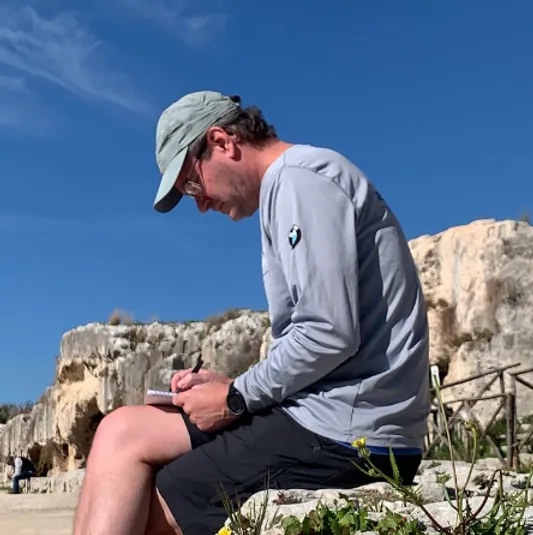
At the necropolis I stood at the gate. This time I carried water, my notebook, even a snack. I stared down the overgrown, hacked-from-stone path. The building was closed, its imprecise map barely visible in the shadows. I wondered about that caretaker, nameless to me, his fate so far removed from my own. I found the old picture of that map on my phone and traced it with my eyes. I looked ahead, down to where the tombs lay, still open and waiting.
And then I realized I already had all I needed from that place. I turned around, back to the car. I drove away, back up the ridge, back through a town that, while beautiful, feels indistinct from a hundred others.
I had returned there because I am human. I did not re-enter because I am human. I had remembered enough, forgotten enough, considered enough to retain a sense of wonder, that joy of discovery, a beautiful, perfect recollection. A recollection that I am absolutely certain is factually flawed and imperfect, but because of that more meaningful to me.
Grief never really diminishes. Subsequent losses attach themselves to whatever anguish first anchored itself within us, adding to its size and weight, or rather its absence of weight. It only feels smaller as the rest of one’s life expands around it. It is absorbed by understanding. Understanding not measured in acquisition of facts or layers of knowledge, but in seeking and empathy, in the amorphous and profound chasms within us, wine-dark seas that alternately ebb and surge.
Everything that I had considered on that warm afternoon in 2020 remains contained within me: empty chambers, the particular loneliness of a solitary traveler forced to reconsider my own future, pondering ancient ideas in a world untouched by the current pandemic, one in which my mother was still healthy and alive, in which we might stay another year in Europe. So much turmoil and grief still lay ahead, then, that now has been sealed behind me. All that knowledge and understanding still lay in the future. The same is surely true right now.
The past, our past, my past, lies underfoot, within the earth, within reach and beyond it. And likewise in memory, accessible but unquantifiable and not fully understood, never to be fully understood. Or it lies here, set upon this page, final and ephemeral.