
Unflinching in its portrayal of the fast life, Joe Pan’s Florida Palms, out this July from Simon & Schuster, is a grounded, human look at the lives of two young men, Eddy and Cueball, who find themselves swept up in a sprawling drug-running operation. Fast-paced and deeply imagined, what is most compelling about Florida Palms is the humanity and depth Pan brings to his depiction of Florida’s Space Coast and its down-but-not-out inhabitants. Our conversation unfolded over email over the span of about two weeks.
***
EVAN FACKLER: Joe, thanks for talking with us, and congratulations on the novel. Florida Palms is a very intense page-turner of a crime novel, but it’s also quite literary in its execution. I’m wondering if, to kick things off, you might talk briefly about your approach to genre and the sensibility you wanted to bring to the book.
JOE PAN: Thanks, Evan. I’ll start off by saying I don’t think of “literary” as a genre, but as an elevation of any genre. For instance, you had Stanislaw Lem and Ursula K Le Guin writing literary science fiction, Cormac McCarthy writing elevated Southern Gothic and Westerns, John LeCarré writing elevated spy novels. What people mean when they talk of “literary novels” is often American Realism, a kind of naturalist, seemingly objective, Cinéma vérité workaday probing into life as it is lived. It’s not by nature any more or less valid than any other genre. I’m honestly not entirely concerned with genre when I’m writing, as I rely on the characters to tell me who they are, what they’re concerned with, and what sort of society they’re functioning in. A book may start with an image, let’s say some guys in a field, but only when they begin to speak do I know where and when they’re living, and what they want. Only then will the trappings of genre concern me. It’s important to know what tropes you’re going to be subverting, because readers inherently know them, so you should familiarize yourself with the history of that genre. And when it’s time to market the book, your publicity and marketing team will need to know who to advertise to, and bookstores which particular section the book should be stocked in.
In the case of Florida Palms, I found myself in a kid’s brain at a biker party, a personal memory of my own, surrounded by a wild bunch of characters: a soon-to-be drug czar biker with a flag tattoo covering his chest, a hitman with a fang who kills people with a blowgun, a philosophizing biker who spoke with an arresting learnedness. I was transported to my youth, among characters who would fit the #FloridaMan bill, but who I knew had a lively interior life I wanted to dig into. It would be a crime novel, I would learn. What fun.
EF: This is your debut novel, though you’re already a well-published poet. Did anything have to change about your writing practice as you worked on the novel?
JP: I’ve worked on this book for two decades, so any established writing practice I may have had has undergone various evolutions. I was always just honing and editing until everything clicked into place. As a poet, my go-to practice has always been to start with language, letting language and imagery find its subject. As a fiction writer, I start with a subject, be it a person or theme or inkling, and work through language to develop character tensions, which eventually lead to plot. Poetry is a puddle of language I slop around in, whereas narrative work begins with a point of view, a human presence. If I over-plot anything I ruin the joy of discovery.
EF: I can imagine a world where two decades of work on a novel might start to ruin some of the joy of the thing. What was it like living with this story for so long? What advice would you give to writers who may find themselves in, say, year ten or fifteen or, heck, year one of a novel and are starting to wonder if this thing can even be done?
JP: You’d think it would get old. But the book kept changing as I changed, which is the mark of any good relationship. One thing I never thought was that it was a failure. It was a loved one, and beautiful, even if nobody else saw it. But I didn’t just work on this one book, I worked on many books, and published poetry, and started a small press, and wrote other novels too, which I’ve been going back to. All writers have, I think, one or two albatrosses they can’t shake. The drawer novels. I was just adamant that this would be my first work of fiction. All the other books I’ve written started out of this one, and so I envision this as a way to decode the others, the poetry books and whatever comes next. The resonances of my voice begin in this work and go off in different directions. Now I’m not advising people to not give up on a book—some relationships must end—and so I offer no advice. This one took a long time to get published, but I published other books in the meantime. My wife had the best advice for me whenever I’d get down on myself: “Just keep making art, let other people decide what to do with it.”
EF: The novel is set along Florida’s Space Coast, which is where you grew up. How essential is that setting to the novel? How did your experience and memory of place inform the story?
JP: Very essential. I threw everything I knew about the place at the book and saw what stuck. I’m a maximalist at heart, and lose myself in research quite often. Too often. I want to drag the reader through the entire experience of writing the book, and good writing means not doing that. Readers have their own lives and deadlines and families—leave them alone and get down to business.
I grew up poor with two younger siblings and an out-of-work divorced mother who had to raise us on less than $100 a month—and yet, my childhood was incredibly entertaining. My mother told great stories, as did my grandmother, a transplant from West Virginia, daughter of a coal miner, who worked in a small capacity for the aerospace industry, creating these large silicon wafers at Harris Corp. These stories were often haunted in nature, either supernatural or violent or dealing with victims of loss. Stories about the unknown or unknowable. Anyhow, my group of friends were big into sneaking out, skateboarding, throwing parties in the woods, getting into trouble, and living fast. And that kind of living brings its own stories, often of a similar nature to those told by my mother and grandmother. I capitalized on this as much as I could. I would always tell people the purpose of living was to make stories you could tell later on.
EF: In the acknowledgements at the back of the book you mention an unnamed fiction editor who told you that “he vacationed in Tampa, and never once ran into characters like those [you] described,” which strikes me as a bizarre critique. But I do want to ask you about your approach to character. I found myself describing the characters in Florida Palms as “swamp biker philosophers” when talking to my friends, and characters like Del Ray and Gumby and Eddy may surprise some readers with their erudition and capacity for introspection and self-awareness. Is that what that fiction editor meant? Is there a danger of being overly literary here?
JP: I think there’s a danger in underestimating or outright refusing to acknowledge the inner life and desires of poor people. It’s a frustrating place to argue from, against the belief that high level reasoning and existential queries are somehow solely the preoccupations of the upper and middle classes. You see it often in political squabbles. Scarcity does not equate with stupidity. In this instance, I just ran into a snowbird who dropped onto a Florida beach once a season and reported back his findings. A Gulf-Coast beach, I should say, a resort town. I doubt he met very many locals beyond those selling t-shirts and piña coladas.
When I was a kid, we’d settle around a bonfire and get drunk and muse about the meaning of things. That was the fucking point. Why are we here? What’s out there? We’d spar on issues of morality and faith. We’d come together to bond and share ideas. We’d pit each other’s opinions against what we saw happening in the world. That’s the beauty of community. But to answer more specifically, I allowed my characters, from the outset, an ultimate vulnerability, which was to communicate their thoughts and feelings in a more exacting fashion. It’s not ‘true to life’ so much as ‘true to experience.’ We may not always have the words for our feelings, but as a writer, you can be generous in such things. You can have your characters express exactly what they wish to, and so I did. This is called writing in the ‘magisterial voice,’ which is one of authority, an authority on the workings of one’s own imagination and self. Which can also be dead wrong. We are often not the authorities on who we are. But we feel like we are.
It doesn’t matter to me what’s literary or isn’t. I’m world-building. The human stuff comes out in the writing, as does my education. It can’t not. We process through language, a human characteristic. I let go of the reins a bit and listened to what was being felt. I recorded what felt important and edited that into a narrative, propelled by tension and urgency.
EF: Your answer reminds me of a great scene early in the novel where Eddy is making a coffee run in downtown Melbourne and feeling a certain way about the vacationers and tourists swarming the shops. I’ll just briefly quote from the passage:
Eddy didn’t know what he wanted from these people, exactly, but it had something to do with paying attention, with respect.
This is such a characterizing moment for Eddy, and also seems to speak to the necessity of this generosity of voice you’re talking about. Could you talk briefly about Eddy and Cueball and the ways their worlds and decisions are impacted, consciously or unconsciously, by their experiences or perceptions of these gazes from the outside?
JP: It’s an interesting thing, calling a tourist destination home. These local kids see vacationing snowbirds on jet skis and skidoos and feel left out. You know how much an airboat ride costs? I wasn’t on an airboat till my late teens. You begin to feel like your home isn’t even yours—it’s rentable property, a distraction from real life. And no real money from the prominent aerospace and defense industries is ever really spent on native Floridian kids. Ditto the health care industry, which thrives off a larger elderly population. Golf courses and condos and hospitals go up and no community centers, skate parks, or recreation centers. Why not just buy a surfboard and go surfing, kid? Well, who’s buying me that surfboard, hoss? I mowed lawns for a summer to afford a skateboard deck—just the deck. We could maybe afford going to Disney once every couple years, that was our vacation. And what happens with bored kids? They drop out. Their ambition burns down. They turn to other pleasures. They make their own fantasyland.
What does Eddy want from tourists? Acknowledgement. Respect as a native. Class is not just economic but a cultural division. Eddy lacks options. His poverty feels shameful, unwarranted, a curse. Politicians accuse the poor of being lazy or stupid, un-helpable, untrustworthy. Asking for assistance is outright embarrassing. When my mother finally broke down and applied for food stamps she cried for hours at our kitchen table. It’s demoralizing shit. And you carry that feeling around into the bustling crowds of shoppers and snowbirds vacationing in a home you can barely afford. I have no earthly idea how snowbirds actually saw us. They paid well not to see us. And we saw them not acknowledging us, and that bred some discontent.
So yes, these issues definitely consciously impacted the boys’ decision to start running drugs. Seeing how others live opens your worldview, and who doesn’t want more options and a better life? Everyone in this book is chasing something—money, respect, salvation, love—but most are driven by a hope to access more options.
That said, it’s very important to note this is all in relation to the outsider gaze, let’s say. As a kid growing up in Palm Bay, I was generally happy. We were forced to use our imaginations a lot. We built forts out in the woods, nailed together halfpipes and skate ramps, fashioned D&D obstacle courses out of used tires in our back yard before LARPing was ever a thing. We manufactured culture from everything around us, including other cultures. Shared recipes, swapped stories. I was an upbeat kid, surrounded by family and friends, writing my little horror tales, swimming, skating, and engaging in vices way too early, perhaps. Eddy and Cueball are reflections of that. Their inner sense of self and comradery isn’t overly influenced by some othering gaze, even if their lives are constrained by a lack of upward mobility. They build their spirits like anyone else, through struggle and curiosity, wins and failures. And it is these bonds of brotherhood and loyalty and friendship that the would-be drug czars Bird and Seizer exploit, knowing the kids won’t turn against each other. Proximity really is the basis for much of our values.
EF: This is really, to me, getting to the beating heart of the novel. I remember sitting in on a panel at AWP on “working class literature” a few years ago, listening to the panelists—all men—read from their work. It was like listening to a game of one-upmanship. How many drugs, how many fights, how many racial slurs can we pack into a scene. That kind of thing. I remember trying and failing to locate my own experience growing up in such a place anywhere in what these guys were representing. I recognized the scenery—the depressing small-town downtown, the rusted out pickup trucks, the Farm Supply stores, the copper-stripped old farmhouses—but not the inner lives of the people interacting with that scenery. Florida Palms has all that stuff—fights, drugs, etc.—but it also, as you say, shows us that characters like Eddy and Cueball and Jesse “build their spirits” in this place, and those spirits are complex, thoughtful, human. Some of the promotional material around the novel situates it as The Outsiders meets Sons of Anarchy. You mentioned earlier the need to be fluent in the history and tropes of the genre you’re writing in, particularly as you work to subvert them. I’m wondering what texts or histories you were specifically drawing on or looking to for inspiration as you wrote? And what were some of the genre subversions or creative play you were interested in bringing to this novel?
JP: This is exactly why I chose to write the book this way, to actually explore the complex interior lives of a small section of disregarded people. Back in the day, it was daytime TV talk shows and shows like COPS doing the exploitation—today, it’s social media, with hashtags and viral videos profiting off sensationalism. Now, I know people do dumb shit, and watching people do dumb shit is funny. That’s not going away. It’s when a population segment becomes a trope that one can’t see beyond when we need to take a step back and recognize these are people, not actors, living in what seems like high rebellion and painful self-sacrifice. Like, what the hell’s going on? What makes Florida Man Florida Man? What’s behind the crazy reckless abandon and drug abuse? Why does it seem like they have nothing to live for?
My plan from the outset was to give the reader some rather unbelievable characters and immediately de-trope-ify them with rich interiors and humanity. Draw the cartoon, but shade it in with a kind of hyper-realism. I think this is how magical realism works, and defines certain incredible Korean horror flicks like The Wailing and Parasite. I have this whole theory. Begin with the absurd, or the comedic, then humanize, then terrorize. If you’re successful, and the reader follows along, the reader will come to understand the other. If I’m successful, readers will understand what drives my characters into acts of desperation. We ask ourselves of serial killers, “How could anyone do this?” And we listen to podcasts and learn the root cause is always abuse and shame. A series of de-humanizing traumatic events during adolescence. I’m less interested in the wild outcomes than what caused them. I wanted to explore the pressures being put on these young men as they attempt to find their places in the world.
EF: Before I let you go, I did want to hear a bit about your choice to set the novel in the aftermath of the 2008 financial crisis. Why return to that particular crisis/moment now?
JP: I’ll share a story. Right around 2009 or so, my grandmother’s house in Florida, which was roughly 850 square feet with three bedrooms—each occupied by struggling family members—was suddenly worth about twenty thousand dollars. My grandmother raised god knows how many kids, grandkids, and neighbor’s kids in that house, and was retired from her assembly line job testing silicon wafers for the aerospace industry. She was not going anywhere.
Anyhow, the house next door went up for sale. Cash only. The entire neighborhood was selling at an 80% discount due to the crash, and guess who was buying? Profiteers. Landlords. The whole state was a fire sale. My mother’s small house in Palm Bay was also devalued, and had a busted septic tank and a janky roof. Why fix it up when we could buy another house in better condition outright for less? I mean, new cars were more expensive than homes—that’s a hard reality right there.
So I mention this house for sale to my mother. I think we can get it for $20k. Move mom in, or make the family some money, or just get everyone out of my grandmother’s house. I talk to my mom about it, we’re on the phone. I tell her I have the money to do it—she says hold on, goes and gets a quarter and flips it four times. It comes up tails three times. No, she says, God doesn’t want us to do it.
The house is now worth ten times the original asking price.
Now, I could stop the story right there, and settle for your tsks and disbelief. Or we can investigate further, and ask why she’d flip that coin in the first place.
Buying seemed like such an easy choice—we could rent it out or live in it. Buy low, sell high. But imagine a mother who doesn’t want her son risking money in a housing market with no apparent bottom. Eighty percent lost on a rug pull nobody saw coming. She’s owned one house in her life, built by my father. Her friends and family are underwater. Only the short-sighted bankers with predatory lending practices are getting bailed out by the government. Just a super frustrating reality. Oh, and the Affordable Care Act isn’t a thing yet—she has no health insurance. She only has what’s in her bank account and her maxed-out credit card.
Let’s take a look at her sense of risk-reward: when you’re living close to the bone, there are no small risks. Everything is all in, with real world consequences. Big purchases are often life purchases. What do you have? Family, friends, your health if you’re lucky. A government more interested in protecting a financial system than helping out those struggling with debt.
So my mother leaned into her faith. Chose her son’s care over possible further financial hardship and blame or resentment. And that sort of self-defeating vote against self-interests should interest people interested in current politics. Call it ignorance, if you like, but there are real world consequences underlying these fears. And love, which must be preserved at all costs, because everything else costs money.
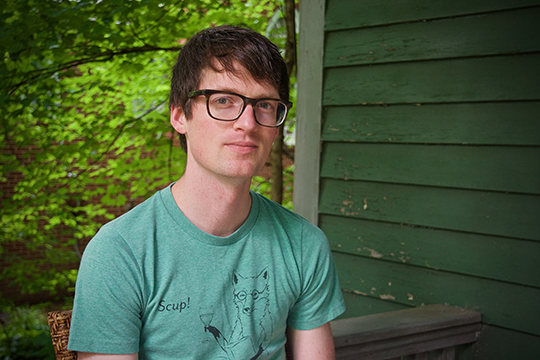
 JOE PAN is the author of five books of poetry and founder of Brooklyn Arts Press, one of the smallest independent houses ever honored with a National Book Award in Poetry. His writing has appeared in