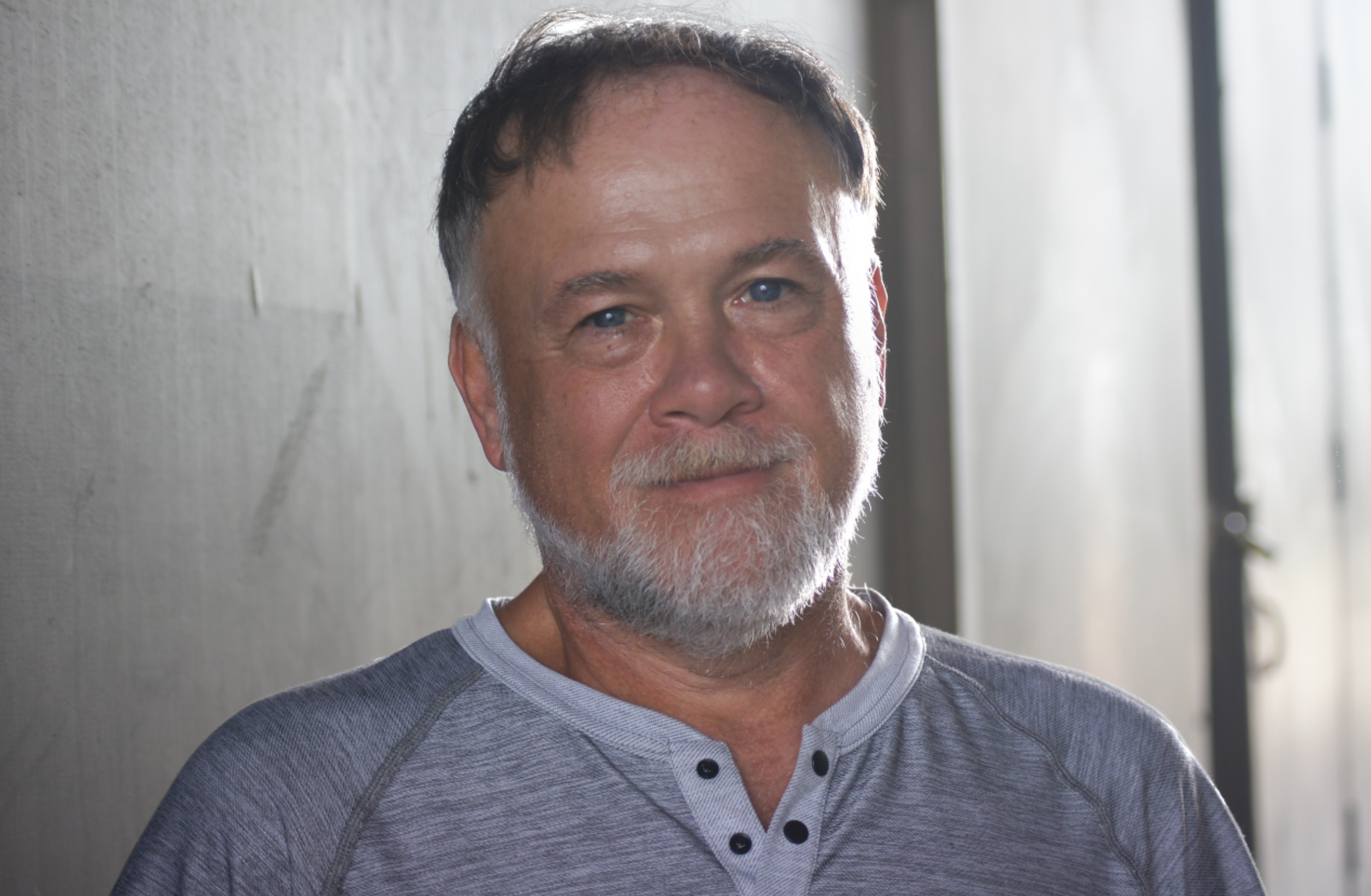
This conversation was conducted on April 3rd, 2025, via Microsoft Teams, with my Advanced/Graduate Poetry Writing Workshop at East Carolina University. Part reading, part Q&A, and part interview, Sean Thomas Dougherty was generous, insightful, funny and engaging. Sean has been deemed, by Dorianne Laux, as “the gypsy punk heart of American poetry,” and he is all that. The larger class conversation included questions from all the students. This edited version includes questions by two of these students. Lindsey Bayes graduated from ECU in May with a bachelor’s degree in English and a minor in Creative Writing. She is currently enrolled in Liberty University’s online clinical mental health counseling MA program. Robert Miranda is pursuing an MA in English with a concentration in Creative Writing at ECU.
Lindsey Bayes: I just wanted to ask what advice you would give to a poet who doesn’t plan on following the classic MFA academic path but still wants to develop their craft and find an audience.
STD: Well, I found that my work influences my writing work, so if you’re working in human services, like if you’re doing Hospice work, what more human experience are you going to have than to take care of people who are on the verge of dying? And so, in terms of what to write about, you’re constantly faced with things to write about. You’re constantly being pushed emotionally. What I found interesting about it is that one who does the medical work that I do, we’re trained with rational detachment, right? I take care of people who have traumatic brain injury, so they might be having bad night, and I might be called motherfucker for two hours, and somebody is saying I miss my children, and I want to go home, but they can’t go home because they live in a facility. And I just try to counsel them down and make sure they’re OK. And really, it just washes over me all that aggression because I’ve been doing it so long, plus, we had some good training, and I learned from older caregivers who modeled the kind of behavior for me. I found that this is exactly what we need as writers.
My worst poems happen when I’m emotionally attached to what I’m putting on the page. You know, this is my emotion, but it’s not. It’s language that we’re putting on the page. Story and structure. So, take that idea of rational detachment, keep your own emotions at bay and really look for what the problem to resolve is here, to understand that this person is having a crisis. How can I get her to a point of resolution and release? This is the same as writing a poem, right? It’s not about our emotions; it’s we have this language on a piece of paper. How can we resolve it to get to where this poem and this language, wants to go? Maybe it’s a question of sound. Maybe it’s a question of narrative, and maybe it has nothing to do with what we originally thought we were going to write in terms of the emotion that we brought to it. This training that you do in conflict resolution or in grief counseling outside of the literary is actually the best training you can have to be a writer. Because I know when I write the poorest it’s when I’m so invested in my work. Too invested emotionally. To make it a piece of art you have to step back. You have to think of it as a rhetorical and commutative act. So that detachment is perfect.
Robert Miranda: I imagine, over time, you’ve gained a dedicated fan base of people who read your work and comment on it. Vice versa, you’ve probably also gotten the opposite, where you have a few people who—I don’t want to use the word criticize. That is, how do you separate the people who know what they’re talking about from those who don’t? And then, how do you separate the opinions that you actually care about—not just personally, but also in an effort to improve your own work— from those that don’t help you?
STD: Yeah, that’s a classic workshop question, isn’t it? Has anybody ever had a workshop where some people say things and it seems very generative. And then, some feel petty, and you ask yourself, why is this person in the workshop? You know, you’re asking, in a broader sense I guess, about literary community and the communities that we make which nurture us and the ones that push against us. I’ve had some experience with bad reviews over the years that seem kind of petty and didn’t really get what the book is trying to do. You know, if you’re really honest with yourself and you read a good review that’s critical, it’s going to help you in your next book, and it’s going to push you forward.
For the most part, I’ve been lucky in that. I try to put out good energy, and that good energy comes back to me. Like your Professor, John, does the same thing. He creates community with magazines, and this is creating community. What we’re doing here. And then you rely on those people because it’s not like people who read my work are “fans.” Not a lot of people read poetry. And most of the people who read poetry are poets. So, it’s like I’m trying to give back to what all those people that I read gave to me. And if you’re honest and sincere about that . . .. You know, in this difficult art, the older you get, you can go two ways. You can become bitter, or you can be kind, and I’ve embraced the kindness role. People who are bitter about this, maybe they should be doing something else because, in the end, we all fail at our poems. We’re never gonna write the greatest poem in the world. Because we fail all the time as people. There is no perfect person out there. We always make mistakes. We say the wrong word. We do the wrong thing, you know, but out of that imperfection, so does our work, with all its imperfections, show something that is so essentially human, right? And sometimes those imperfections fit with the imperfections of another poem and another person. And out of that becomes a wholeness, and it’s that wholeness that I look for among people. Like, what are they doing? Are they invested in their art? Are they being genuine with me as I’m being genuine with them? You know, what are they offering me? And what am I offering to them. Not in a transactional manner, but more as in a huge collective of artists who together are all writing and shaping, in some strange way, not a million different poems but one giant tapestry poem that collects and sings and hums altogether.
Sometimes, when I go to a conference or reading where there are multiple poets, what I’m struck by is not the individual readings but what I’m hearing collectively by all those voices speaking together. If I had to think of a metaphor for the community of poetry, it would be more like being a part of a chorus than an individual singer. We’ll all have our little part to sing in that chorus. But without each one of us, something would be lost. That also is a way to give us validation, because sometimes it’s easy to feel obscure. Or unwanted or unread. But if you think about it that way, that my voice is just as important as the other voice in the front row, and I’m here, and that without us, we would all be a little bit more diminished, it’s one of the things that helps to keep me going, to keep singing. And to keep wanting to hear new songs that will invest themselves into my life. Did I answer the question? Because I was getting all churchy there, right? [laughter]
JH: Yes!
STD: Amen. Can I get an amen?
JH: It’s gospel.
Robert Miranda: When you’re writing about experience, how do you decide when a poem is done? How do you decide what details are necessary to the story and which aren’t?
STD: You know, that’s a great question. Yeah, that must come up in your own work, right?
Like when is it done? I always tell the story about the jazz musicians John Coltrane and Miles Davis, when they were playing together and they put out one of the greatest jazz albums, Kind of Blue. And John, he would go into these huge, long solos, but one day he turns to Miles and says, “Miles. Miles, man, you know, I so get into these solos, and they just take over and I just keep going and going and going and you know, it’s like I can’t get out of them. I don’t know where to stop. And Miles looks at him in that cool Miles Davis way and says, “Take the damn horn out of your mouth.” And I love that because sometimes, you know, a poem is done when we, you know, we just write the end, you know, stop writing. I mean, that’s a great story. But it’s facetious, right? It doesn’t really get to the issue because a solo doesn’t really just end because you take the horn out of your mouth. I found that I write circular, so I’ll introduce a sound. Sometimes a theme or simple phrase, like “The things that fall.” And then I will go back. I will use that to generate the details, and the poem becomes circular and most of my recent work is like that. There’s a circularity to it. Also, paying really close attention to the sounds that are driving a poem. Sometimes you’re not ending it because the sound is not clicking. Is there an O sound four lines up that cries for another word with an O so that suddenly the poem stops itself just based on sound there. And those are the kinds of late revisions I do a lot. I look at the end and say, okay, sonically, what is this doing? I read it out loud sonically. Is this closing up? Sometimes it’s closing up in terms of meaning, but the sound isn’t right. The sound has to be right, too.
Lately I noticed—my wife, who’s a writer, pointed this out—that I’m ending on a lot of actions and images because I’m writing poems that have lots of people in them, and so somebody’s doing something in the last line, you know—which I think is also a product of the fact that I’m writing a lot of prose poems, so I’m using the sentence as the unit of measure more and more rather than the line.
JH: Sean, I conducted an interview with you back in late 2016 where you state, “I don’t write much anymore. I finished my next book for BOA Editions, and I’m done for a long time.” The BOA book, The Second O of Sorrows, appeared in 2018. But here’s the thing: an anthology you edited, Alongside We Travel: Contemporary Poetry and Autism appeared in 2019; a book of poetry, Not All the Saints, appeared in 2020; a book of poetry, The Dead are Everywhere Telling Us Things appeared in 2021; a book of collage, prose, poems, stories and essays, Death Prefers the Minor Keys, appeared in 2023. So, you lied? What happened?
STD: That’s what poets do, right? We lie, right? Yeah. [laughter] I stopped writing after I finished The Second O of Sorrows because, you know, because, to me, after I wrote that book, I was like, I don’t think I can do any better than this. I had finished that book I think right around 2015 and didn’t write much for the next few years. Just notes and ideas. So, I took a break, and I really didn’t generate much work after that book came out.
The Autism project was a sort of collective. I just asked on Facebook one day, who writes about autism? Suddenly 100 people responded. “I have an autistic son” or “I have an autistic sister.” And so that came out of just a sort of collectivity of us. But the other two books—and I’m sure you can identify with this—I had a lot of poems that weren’t in books, so those two next books were a combination of work that was much older, that I had written and saved, and then I added a little bit of newer work. So, it’s not like I generated all those books in that short amount of time. I had other manuscripts or pieces or manuscripts and things that weren’t developing, so I took poems from those. Really, the only book that I actually wrote during that time was The Dead are Everywhere Telling Us Things, though even the long collage poem in there has pieces in there which go way, way back. So those weren’t all written during the pandemic; some of those pieces go way, way back then I just kind of weaved and collaged a lot of things together. I’m a recycler. I write little notes. I’m always writing, but I’m not always writing poems, and even back then, when I said I’m done, I’d still be taking notes. I take notes of the world or things that people say, or an image, and I put them on these little pieces of paper. They’re just everywhere. You know, my pockets. And eventually I take them out, and I start to put them together. So, I always have something that I’m working on.
JH: In that same interview you state, “I’m not really sure about any of this anymore. Honestly after fifteen books, more than most, less than some, after reading in so many countries, and touring the country to perform at over one hundred universities, I have become someone far from anything literary, anything I could call a ‘career.’ I guess I could close by saying what James Wright wrote at the end of one of his poems, ‘I have wasted my life.’” Do you really think that’s true? And what would you have done instead, if you hadn’t written poems.?
STD: Yeah, in some ways I do think that’s true because, when I was younger, I wanted to be a flute player. I was really, really into music. And there was a point when I was seventeen, where I suddenly realized I had to spend a lot of time alone in a room by myself to be a really good musician because you have to practice constantly. I still play. I still remember that feeling when I decided not to go to school for that and, ironically, I became a writer.
But what do we do as writers? We spend a lot of time in a room alone by ourselves. And I think what I regret, if I regret anything in my life, is—I always argue that writing is for others. We don’t write our poems for ourselves. We write them in the hope that they will help somebody who’s going through something in their life or who just wants something beautiful. It’s about the reader. But since I’ve been working in social services for the last ten years—I don’t want to say that it’s not that important, because I do believe that art is really important—but for me, I wish I’d come to that decision earlier in life. I wish I had just tried to help people with my ability to take care of people, because not everybody can do this work. Not everybody can just let things fall off them. And for me, for some reason, that’s a natural ability. I think part of it is a class thing because you get used to being yelled at when you’re working class. [laughs]. Maybe if I’d taken some of that time that I put into writing poems into taking care of real human beings, in a way which might have—I don’t know. It’s what I do. You know what I mean? I don’t want to devalue the writing of poetry at all, but at this point in my life, I’m more interested in those real human moments where, out of the ordinary day, something extraordinary happens. Where somebody’s having problems and difficulties and, just by being professional—because that’s what we do as caregivers and techs, we’re professional—we help them get to the next day. And to me, that’s the real work. I’ve started to think of my poetry as part of that. But I put the real work first, I think.
JH: So, I can maybe predict how you might answer this next question because of how you answered that one. But I’m going to ask it anyway. I think that those of us who do what we do and are not afforded the privileges at academia affords, the expectation of presenting our creative work as part of the expectations of our jobs and the providing of some resources to help make that happen. The nine-month teaching contract. The ability to access literary structures that are often difficult for non-academics to participate in, and so on. Those writers may well find the challenges of being what I think you are, though you may be too humble to say, what I called you in my introduction earlier, a latter-day griot of sorts. A travelling poet and storyteller. One who keeps alive the necessary tradition of creating, saying, and preserving our oral history and spreading the word. Do you see yourself that way, and do you regret, maybe, not having chosen the academic life. I mean, I know you’ve had a taste of it and maybe that’s why you haven’t, but . . ..
STD: No, I don’t. I don’t regret it. I guess I don’t regret it because I feel for everybody in academia now because the sort of change in corporate structure, the rise in tuition rates. When I went to college—I shouldn’t tell you guys, but my first semester at the University of New Hampshire was $480. Back in 1986. So, I love what university is supposed to be about—that shared community of knowledge and learning, but more and more it’s becoming so corporatized, so monetized, and the pressure put on faculty, and you’re asked to do so much. Like John, you probably work way harder than I work. [laughter]
JH: I don’t know.
STD: I’m just passing out a couple meds, you know?
JH: Like you, there was a lot of manual labor in my youth and, yeah, maybe you’re right. In some ways this is harder, but . . ..
STD: Yeah, yeah. And then you’re all—there’s a performative aspect to academia. You’re constantly being evaluated. So, in the work I’m doing, I’m being evaluated. If I give somebody the wrong med or somebody falls and I don’t, you know, you know, my evaluation is actually that. But how your work is being looked at, that’s really hard. It’s really difficult. I like teaching, but I didn’t like the rest of it. I was an administrator at Case Western [University] for one year, of their foundation writing program. It was the worst year of my life. It was just e-mail, emails and memos and . . .. I got to teach one class, and I loved that class, but the rest was just, oh God, it was endless. [laughter]
JH: Lots of meetings.
STD: I don’t even remember what the question was; I’m getting so sad. [laughter]
JH: Yeah, I know that I’m lucky. As part of that work, I get support and have expectations that allow me to go off and give readings and get support from school to do that, but you don’t have that. So, there are these perks, you know, which may not be—
STD: Bye. Right.
JH: here much longer, so maybe you’re right. [laughter]
I wonder what your thoughts are, given that you work in the health field, on the rapidly expanding and more and more accepted areas of artistic expression we call narrative medicine and medical humanities and does any of this go on where you currently work.
STD: No, it doesn’t come up where I work. What I’ve learned about it is just from people in the field, like Tracy Brimhall, have told me things about it. To me it seems a natural rise, particularly with the aging population that we have. Our parents were the baby boomer generation. It is getting so old, and we’re all writing about it, and I think the work is generating part of that in the field. You know, people are actually writing about medical issues because of the pandemic. I mean, the pandemic raised that issue to the forefront, but that’s far removed from what I do, in the daily, but I probably should learn more about it. I like that it gets back to some of the older roots of American poetry, where people like William Carlos Williams was a doctor, and I like the idea of just generating work in different fields, you know? We should really have literary work in all our fields. Like when you take a science class, wouldn’t it be awesome, when you’re doing a section on botany, that you’re reading all these poems about flowers? Going all the way back with Wordsworth, those beautiful landscapes that he does. Or when you’re in math, a poet like [Vladimír] Holan from Czechoslovakia, who was a virologist and a scientist and wrote these strange poems with mathematics, too, at times. So, what if our work is all over the place? And that’s what I do like about the medical humanities is taking literary work and crossing more boundaries.
This gets us to you guys. You’re writers, too. How could you use your work in ways that aren’t just in the defined literary parameters or spaces and put that work out there into different fields of knowledge, to conversate with it.
JH: Maybe to build off that, it seems less and less likely that my students here tonight, like students in MFA and MA programs throughout the land, will be able to occupy the academic space we talked about earlier. I’ve heard academia called the modern patronage system for artists, though I don’t agree, fully anyway. But it seems to me that the spaces that my students are going to be occupying will look a lot more like yours probably than mine. What words of either gloom or hope might you offer them as they negotiate the desire to be creative writers and who also need to find a path in their lives to making some money and surviving.
STD: My job is tough. Like it’s really tough some nights. I mean, I’ve got to go to work tonight, and we have some stuff going on there. It’s gonna be some chaos. I know that going in, but when I come home, it’s done. And so I have time to write. Yeah, that’s the difference between teaching not coming home with the giant stack of portfolios and papers. There’s always time to write. So that idea of just being a professor is more of a me and your generation, John, than it was historically for the whole of American poetry. So, if you’re gonna write, you’re gonna write. That’s one thing that I found out, and if you’re not gonna write, that’s OK because you’re still probably listening and interpreting the world. This is one thing, as we as we close up, that I want to say it to the students: not writing is never a question of time. There’s always time. This last book I wrote, Death Prefers the Minor Keys, I wrote almost the whole book on Post-it notes and scraps of paper over two years, and that book’s big, so there’s always time to write. If you want to be a writer, you’ve got to embrace that.