
Objects of Desire, Adam O’Fallon Price’s debut story collection, arrived in bookstores earlier this month. Winner of the 2025 Autumn House Fiction Prize, its eleven stories—about artists, writers, and dreamers of all kinds—are routinely devastating. Shining through their darkness, though, is an underlying tenderness and empathy for the characters whose foibles, mistakes, waywardness, and selfishness he depicts with a searing clarity. The cumulative result is a collection at turns heartbreaking and transcendent. Price is the author of two previous novels, The Grand Tour (Doubleday, 2016) and The Hotel Neversink (Tin House Books, 2019).
*
EVAN FACKLER: Thanks for talking with us, Adam. This collection was such a pleasure to read. Gripping, heartbreaking, electric. I wonder if you might start out just by talking a little bit about the collection as a whole. How it came to be, and your process for putting these stories together.
ADAM O’FALLON PRICE: Thank you, I’m really glad you enjoyed the stories. “How the collection came to be” really has two answers—sort of what the impetus for its existence is, and how it was constructed more on a creative/editorial level.
The first part is, I’ve always wanted to have a story collection, but whenever I’d take my agent’s temperature about it, she thought it was not a great idea. Just in terms of publishing chances—the common wisdom is that story collections have to be sold with novels and that there’s very little interest in them. Which is largely true, although it’s probably also a self-reinforcing belief—but that’s a different conversation. Anyway, I put the idea on the back burner for many years, during which time I accumulated publications in good places. A year or so ago, after publishing a couple of novels, I realized that I still wanted to have a collection—more than ever, in fact—and that I should just enter a few contests. I put a collection together and was lucky enough to win the Autumn House Fiction prize.
As far as what putting a collection together entails… For me, the main challenge was mainly just picking the ten or so stories. I wanted it to mostly be published pieces, which helped narrow things down from hundreds of stories to about thirty. Really, it wasn’t that hard picking them—the ones that made the collection are, I think, among my best, and they’re thematically resonant in a lot of the same ways. I think I also wanted the collection to have a certain sustained tone, I suppose very dark comedy, for lack of a better descriptor, and all of these stories are pitched in that range.
The ordering of the collection was the most interesting part, for me. I’ve written and recorded music since I was in high school, and so I naturally thought about it in terms of a record. I’ve made probably ten albums at this point, and I have a lot of very bespoke theories about how they should be sequenced (I mean vinyl here btw, I realize that this is nonsense in terms of streaming). The collection has the title story, “Objects of Desire,” in the middle, 6 of 11, and it acts as sort of the interlude between the two “sides.” Side A, i.e. the first five stories, is, like a lot of albums, a little catchier, a little brighter, sort of stuffed with the “hits,” so to speak. Side B, i.e. the last five, is darker and weirder. The last story, “Schenectady,” is, like the last song on a good album, the most important song in a certain way. It’s the piece that (hopefully) both brings everything home and to a close, and also makes you want to experience the thing again.
EF: That’s interesting. I do want to circle back to “Schenectady” in a moment, but first I’m glad you brought up “Objects of Desire” early in the conversation. It’s by far the shortest piece of the collection, at around 140 words—yet it’s a kind of distillation of the tension that seems to sit at the center of all of these stories. It’s silly to summarize a flash story, but here goes: it’s the story of a boy who, drunk one night, steals a macaw from a pet store. He probably describes the impetus behind his actions best: “It was a long story, but basically: he wanted her, she wanted the bird, there you had it.” Waking up the next morning, he realizes how foolish he’d been. The girl wouldn’t want anything to do with this bird or him. Worse: he was probably headed to jail. The critic Lauren Berlant might categorize this mismatch between desire and effect as a form of “cruel optimism,” wherein an earnest desire or attachment comes to cause active harm. Could you talk some about how desire operates throughout this collection, because we see some form of this cruel optimism again and again?
AOP: Yeah, I mean I think you nailed it—characters have to cruelly (on the part of the author) be bestowed with optimism for stories to work, generally. Optimism in terms of, even if they are depressed and cynical, they need to have desire, and desire itself is inherently optimistic—wanting something is a form of hope, and desire is opposed to despair. You cannot write about a character without any desire, in total despair. Characters have to want things and wanting things has to create problems. Or the wanting itself is a problem.
I read Flannery O’Connor closely and intensely when I was getting started, and boy is she the master of cruel optimism! I think of her stories as “torture boxes,” made-to-order spaces designed to cause the maximum amount of suffering for whichever character is unlucky enough to be her protagonist. She’s an extreme example—the cruelty is so excessive, I actually found it difficult to read her the last time I tried recently—but even gentle authors have to find ways to create difficulty for their characters. There’s not a story otherwise. And so there is something inherently cruel, I think, in story writing. Productively cruel, hopefully, not malicious. But cruel.
EF: But also maybe something cruel about the desire to write—or to create—itself? I’m thinking about all the stories here about artists—writers, sculptors, athletes—whose relationship to their craft comes to feel quite a bit like that boy’s desire for the bird in “Objects of Desire.” Like the old sculptor in “A Last Chance in Whitefish” who gripes about “the danger in making things.” Or the friend in “Kimono” who says, semi-humorously, “Well, writing is depressing.” I don’t put much stock in the suffering artist mythology, the idea that great art requires suffering, and I don’t have the sense that you do, either. And yet there’s something in that desire—that relationship between art and the artist—that does seem, more often than not, quite fraught.
AOP: Yeah, I think wanting things is always fraught. Because you never get exactly the thing you want, or you get it too late, or not in the form you were expecting. And being creative, making art, is a way of wanting. It’s a kind of nebulous wanting to express yourself and for that expression to be received well by other people. Being creative really involves a lot of desire, and wherever there’s desire, there’s personal risk. Which of course is where story comes from. A lot of people dislike stories about writers, but I love them. I mean, there are few ways of being that involve more desperate, uncontrolled, uncomfortable, perilous wanting than writing something. All the different ways of wanting knitted up in the single impulse to write a story. It’s amazing.
I think I tend to write about either writers and artists, or more broadly creative people, and even more broadly about people like Leigh in Stone Lions, who is an athlete—not a creative expression per se, but a pursuit with that kind of single-minded desire. I almost have trouble conceiving of characters who are not creatives, I mean the inner life of people who just go to work and have families, which is most people. Even Steven, in “Marrow,” is a real estate schemer and dreamer, which is sort of creative-adjacent in a way. For me to be interested in a character, they have to have that weird inner fire, that stupid thing they want and probably can’t have. I don’t really understand people otherwise, which is maybe a bad admission, but true.
EF: I’ve been holding off on talking about “Schenectady” mainly because I wanted us to dwell in some of the darkness of the collection for a bit. And “Schenectady” is dark too. But it ends on a note of lightness as the narrator, a down and out screenwriter who has found herself—in a way that is surprising even to her—in Schenectady to teach a screenwriting class to gifted high schoolers, experiences a kind of epiphany: “I saw that rather than needing resolution, this uncertainty was the entire point,” she writes. That can be a hard thing to come to terms with. There’s a similar moment that comes at the end of “Going Underground.” You’ve said “Schenectady,” like the last song on a good album, is meant to bring everything in the collection to a close. Can you talk some about what this space represents for Allison (“Schenectady”) or Alice (“Going Underground”), and perhaps also what it represents for you and for this collection? I’m also just realizing how similar those two characters’ names are…
AOP: I assume when you say “space” you mean the space of uncertainty that Alice talks about? If so, yeah, I think the thing she comes to is this realization that there’s not a place you can get to where everything’s okay. Drugs are the illusory version of that place—drugs really do create that space, which is the problem with them, haha—but in actuality, there’s not any there there or anywhere. There’s not a center, and what she’s possibly learning is that to be able to be happy (and thereby to be able to be sober, and continue living her life), she has to become able to live in this state of uncertainty, between everything, that that’s where life really is. Drugs are, in many senses, a way of being certain: you know what you need, you know how to get it, you know what it’ll feel like, and you know for how long. Writing and creativity, I suppose, offer a certainty of their own: and yet ultimately in the long run, you’re never really getting to any particular place, and you have to be good with simply doing the work—one must imagine Sisyphus happy, basically.
EF: Yeah, by “space”—and apologies for using such a wishy-washy term—I guess I meant both the psychic space of accepting uncertainty—which you covered—but also the physical conditions around arriving at that acceptance. Something that struck me about the endings of both “Schenectady” and “Going Underground” is how they leave their characters in communion with others. And also in a place of, I suppose, renewed interest in something beyond themselves: in the flight of this drone, or in the obsessive collection of things this med tech has removed from people’s bodies. It’s like Sisyphus on that hill taking a short break from his endless toil and looking around to find, hey, what do you know, there’s somebody else there with him. I don’t know, is that off base?
AOP: No, that’s spot on, really good observation and question. You know it’s a good question when it makes you realize something you think that you haven’t ever realized you thought. I do absolutely think that so often, in stories and in life, the solution to one’s troubles is other people and the world. Getting out of yourself—the feedback loop of worries and fears and pridefulness and judgments, and just in general away from that fundamental you-ness—via interest in other people. Curiosity is, I think, what I mean. Curiosity about the world. It’s a bit of a chicken-egg problem, because a deeply depressed person will have a hard time being genuinely curious about other people, but I do think these things are related—the idea that the way out of your problems is just to think about them really, really hard is appealing and also totally wrong. You address your problems by getting out of yourself and into the world.
It’s not hard to see how this relates to writing. At the very bottom of my compulsion to write is a curiosity about other people, what it’s like to be another person—that putative hell. I think for many people, writing is a deeply self-indulgent act, and it can be for me, as well, but I do think that the underlying impulse and the best forms of the art, are about connection with other people and seeing the world through other eyes than your own.
EF: Something that’s particularly palpable in these stories is their feeling of tension or forward momentum. How do you approach creating tension as you write? As a teacher, how do you talk to your students about tension?
AOP: At the start of my intro to fiction classes, I provide my beginner students with a definition of story that is my creation: A story places a character in a situation that puts them under pressure and causes them to change. This is the closest I’ve come to a definition that encompasses almost all fiction written in the modern western paradigm. A character has to be met with some difficulty, it has to cause them trouble, and this trouble must at least offer the possibility of change even if they aren’t up to it.
Tension is basically the byproduct of that trouble, an effect of the increasing pressure on the character. Tension means the story is working. Because the reader senses that there’s complication happening, and that there’s some kind of urgency in the proceedings. I could talk about stakes here—tension has to do with rising stakes, something increasingly hanging in the balance. I could talk about conflict, too—in a way, tension is the passive or chronic version of conflict, the thing in the background, while conflict is the active, acute thing in the foreground.
The funny thing about teaching fiction—it sometimes feels like a kind of dirty little secret—is that all of these narrative elements we talk about in workshop: stakes, consequentiality, antagonism, conflict—and tension, certainly—are all aspects of the same thing. Basically, a story is a problem, and all of these different ways of talking about it and analyzing it are like looking at the problem from different angles.
EF: Michael Parker once told me that, for him, writing short stories was like working as a day laborer, and working on a novel felt more like having a steady job. I interpreted him as meaning that both were work, but that there was a predictability to the labor of a novel that he found to his liking. I’m wondering how you see working on a short story versus working on a novel? They’re wildly different forms, but is there one you prefer over the other?
AOP: I agree with that description—with a novel, once you know what you’re doing, you’re clocking in every day and doing it. That’s true of short stories to some extent, but in the same time-frame it takes to draft a novel—a year, let’s say, optimistically—you might have drafted four or five short stories, lived in the minds of many different protagonists in many different settings and milieus. I mean, you might also roam around in a rangy novel with different protagonists, but you’re fundamentally staying with the same premise and set of thematic concerns.
For that reason, and many others, I definitely prefer writing short stories over novels. Not just saying that because I have a new short story collection, ha. Novels are grueling and stop being fun long before the last draft. Many, many drafts before that. Short stories, of course, also involve painstaking work, but short stories are a perfectible form, and so all that toil feels like polishing something (a turd sometimes, admittedly), where novels often just feel like an endless murky trudge.
But I also simply prefer short stories as a form. They are capable of a kind of compressed beauty and sharp surprise that novels mostly don’t or can’t offer. Novels are great in their own capacity, and they can do things stories can’t—they can create a world, physical and mental, that readers inhabit—but again, I am charmed and seduced by the power and economy of short stories, the way you can render an entire life, largely via suggestion.
EF: Last question. You’ve talked about your affinity for writing about creatives, and also about the darkness that seems to come with the wanting—the desire–to create. How do you confront—and persist through—that darkness? And has it, as it does for Allison at the end of “Schenectady,” changed over time?
AOP: The place I always return to with writing—the still center, as they sometimes describe it in mindfulness—is just the work itself. Like, this thing can drive you crazy if you let it—writing and all of the attendant stuff about writing… there’s so much painful wanting with it, and this feeling that the center is always somewhere besides where you are. And you never get the things you want. Not to be too thematically neat here, but the objects of your desire as a writer, maybe as an artist, are always a little out of your grasp, and by the time you get them, you don’t want them anymore. I mean, think about how perverse writing a novel is—whatever experience or feeling or question pushed you to write one, by the time you’re done and the book is published, it’s mostly irrelevant to you, and often feels like it was written by a different person.
Anyway, that’s a very long-winded preamble to saying that the only way to confront and persist through that darkness (which is of course inside your own self) is to focus on the work at hand. The work of that day, that hour, that minute. That’s what matters, and it’s the tritest and truest thing in the world to say so. The only thing you’re assured of getting—the only thing you actually do get—is the experience of doing the work.
My new novel has an epigraph from Ecclesiastes, which I love, because I think more than any other piece of writing (except maybe Camus’s “The Myth of Sisyphus,” which I think of as kind of a companion piece), it captures the amazing and beautiful futility of work. Just this endless dialectic of “all work is vanity, but there’s nothing better than work.” I think that’s the place Allison finds, in “Schenectady,” to go back to that question—I mean, living in that kind of place of unresolved, unresolvable, tension. And that’s the same place I find in the darkness, in working.
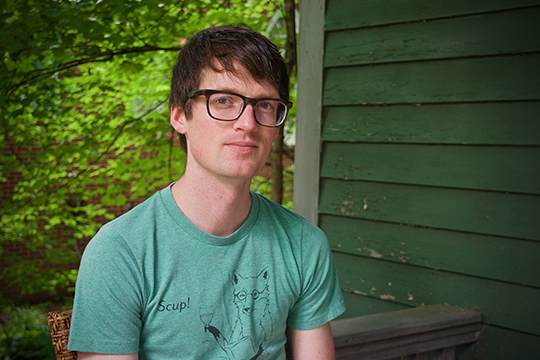
 Adam O’Fallon Price is a writer, writing teacher, and musician living in Carrboro, NC. His first novel, THE GRAND TOUR, was published by Doubleday Books in 2016, and his second novel, THE HOTEL NEVERSINK, was published by Tin House Books in 2019 and won the 2020 Edgar Award for Best Paperback Original. His short fiction has appeared in the Paris Review, Granta, Harper’s, VICE, and many other places. His third book and first short story collection, OBJECTS OF DESIRE, was selected by judge Alexandra Kleeman as winner of the 2025 Autumn House Fiction Prize. OBJECTS OF DESIRE collects many of Adam’s published stories (and a new one) in one handsome volume.